
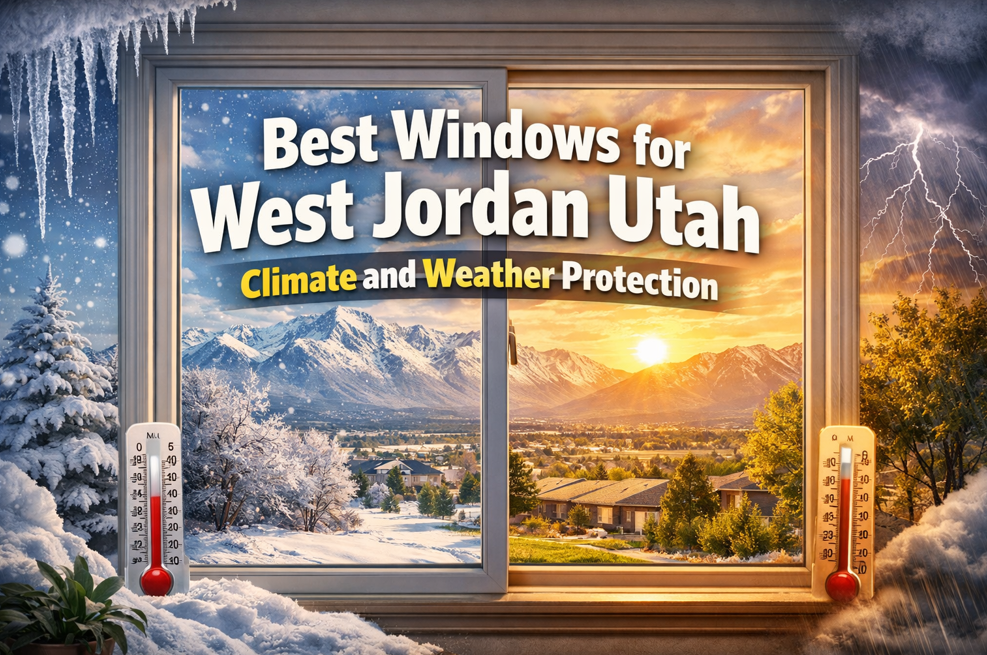
Best Windows for West Jordan, Utah Climate and Weather Protection
West Jordan’s unique position in Salt Lake Valley creates specific climate challenges that directly impact window performance. The city sits at approximately 4,330 feet in elevation, experiencing intense sun exposure, dramatic temperature swings, and occasional strong canyon winds. Selecting the right windows requires understanding these local conditions and choosing products designed to handle them effectively.
This comprehensive guide examines climate-appropriate window options for West Jordan homes based on elevation, weather patterns, and neighborhood-specific considerations.
Understanding West Jordan’s Climate Challenges
West Jordan experiences a semi-arid climate with four distinct seasons. Summers bring intense heat and UV exposure while winters deliver freezing temperatures and occasional heavy snow. The city’s location creates unique weather patterns that significantly impact window performance.
Elevation and Sun Exposure
At 4,330 feet above sea level, West Jordan receives approximately 15% more UV radiation than sea-level locations. This increased solar intensity accelerates window seal deterioration, fades interior furnishings, and increases cooling costs during summer months. According to the U.S. Department of Energy, proper glass coatings can reduce UV transmission by up to 99% while maintaining visible light.
South and west-facing windows experience the most intense exposure. Homes in neighborhoods like Oquirrh Shadows and River Ridge facing the Oquirrh Mountains receive direct afternoon sun that can raise interior temperatures significantly.
Key Climate Statistics
- Average summer high: 93°F (July)
- Average winter low: 21°F (January)
- Annual temperature range: 70°F+ variation
- Average annual snowfall: 63 inches
- Average sunny days: 222 days per year
- Typical daily temperature swing: 25-35°F
Temperature Extremes and Thermal Stress
Daily temperature swings of 25-35°F place significant stress on window components. Frames expand and contract repeatedly, potentially causing seal failure, warping, and operational problems. This thermal cycling is particularly problematic for homes built in the 1970s-1990s with original single-pane or early double-pane windows.
Clay-heavy soils common throughout West Jordan contribute to foundation settling. This gradual movement can distort window frames over time, especially in older neighborhoods like Gardner Village and South Valley where homes predate modern foundation techniques.
Wind Patterns and Weather Events
West Jordan occasionally experiences strong winds from canyon systems to the east. These wind events, typically occurring during spring and fall transitions, can reach 40-60 mph in exposed areas. Properly rated windows with adequate structural support resist these forces without damage or air infiltration.
Severe thunderstorms bring hail risks during spring and early summer. Hail-resistant glass or impact-rated windows provide additional protection for homes in exposed locations.
Glass Technologies for Utah’s Intense Sun
Glass selection significantly impacts comfort, energy costs, and interior protection. Modern glass technologies address West Jordan’s unique combination of heating and cooling needs.
Low-E Glass Coatings
Low-emissivity (Low-E) coatings are microscopic metallic layers that reflect infrared light while allowing visible light transmission. These coatings reduce heat transfer in both directions, keeping homes cooler in summer and warmer in winter. For West Jordan’s climate, dual-pane windows with Low-E coatings typically reduce energy consumption by 20-30% compared to standard clear glass.
Different Low-E formulations serve specific needs. Low-E² coatings (also called “hard coat”) maximize solar heat gain for homes, prioritizing winter heating efficiency. Low-E³ and Low-E⁴ coatings (soft coat) minimize solar heat gain, making them ideal for west and south-facing windows exposed to intense afternoon sun.
Most West Jordan homes benefit from Low-E³ or Low-E⁴ coatings on south and west windows, with Low-E² on north and east exposures. This combination balances year-round performance without excessive cooling or heating costs.
Tinted and Reflective Glass
Tinted glass absorbs solar energy rather than reflecting it. Bronze, gray, and green tints reduce glare and heat gain but also decrease visible light transmission. This trade-off works well for windows where natural light is less critical, such as bathrooms or rooms with multiple window exposures.
Reflective coatings provide superior heat rejection but create a mirrored exterior appearance. These are generally more suitable for commercial applications or modern architectural styles where aesthetics align with the reflective look.
Gas Fills for Enhanced Insulation
Argon and krypton gas fills between window panes improve insulation beyond air-filled units. Argon gas, the most common option, reduces heat transfer by approximately 30% compared to air. This improvement translates to better comfort during West Jordan’s cold winter nights and reduced strain on heating systems.
Krypton gas offers superior insulation in narrower spaces but costs more. Triple-pane windows often use krypton in the smaller gaps between panes, maximizing thermal performance for homes seeking premium energy efficiency.
| Glass Package | U-Factor | SHGC | Best Application |
|---|---|---|---|
| Double-pane, Low-E, Argon | 0.26-0.28 | 0.27-0.30 | All orientations, standard performance |
| Triple-pane, Low-E, Krypton | 0.17-0.20 | 0.21-0.25 | North-facing, maximum insulation |
| Double-pane, Low-E³, Argon | 0.27-0.29 | 0.19-0.23 | South/west-facing, solar control |
Lower U-factor = better insulation | Lower SHGC = less solar heat gain
Frame Materials for Temperature Extremes
Vinyl Window Frames
Vinyl dominates the local market due to low maintenance, good thermal performance, and affordability. Modern vinyl frames incorporate multi-chamber designs that reduce heat transfer while providing structural strength. Quality vinyl windows resist Utah’s UV exposure without fading or becoming brittle.
However, extreme temperature swings can cause expansion and contraction. Proper installation with adequate clearance prevents binding and operational issues. White and lighter colors perform better than dark vinyl in full sun exposure, as they absorb less heat and maintain dimensional stability.
Fiberglass Window Frames
Fiberglass offers superior dimensional stability across temperature extremes. The material expands and contracts at nearly the same rate as glass, maintaining seal integrity and preventing stress cracks. Fiberglass frames can be painted any color, providing flexibility for matching various architectural styles common in West Jordan neighborhoods.
The higher initial cost is offset by an extended lifespan, typically 30-50 years with minimal maintenance. Fiberglass performs exceptionally well in West Jordan’s climate, particularly for large windows or in homes experiencing foundation movement.
Wood and Wood-Clad Frames
Wood provides excellent natural insulation and traditional aesthetics valued in older West Jordan neighborhoods like Gardner Village. However, Utah’s dry climate requires regular maintenance to prevent splitting and warping. Wood-clad windows combine wood interiors with aluminum or vinyl exteriors, reducing outdoor maintenance while preserving interior beauty.
Wood windows work best when protected from direct weather exposure. Homes with deep eaves or covered porches can successfully use wood windows without excessive maintenance requirements.
Aluminum Window Frames
Aluminum frames suit contemporary homes and commercial applications. The material’s strength allows thinner frames and larger glass areas. However, aluminum conducts heat rapidly, requiring thermal breaks to prevent condensation and energy loss. Modern thermally improved aluminum frames perform adequately in mild climates but may underperform in West Jordan’s temperature extremes compared to vinyl or fiberglass.
West Jordan’s clay soil causes gradual foundation movement. Fiberglass frames’ flexibility accommodates this settling better than rigid materials, reducing the likelihood of seal failure or operational problems over time.
Energy Efficiency Considerations
Energy-efficient windows reduce utility costs while improving comfort. Understanding performance ratings helps homeowners select appropriate products for local conditions.
ENERGY STAR Ratings for Northern Climate
West Jordan falls within ENERGY STAR’s Northern climate zone. Windows qualifying for this zone must meet specific performance criteria: U-factor ≤ 0.27 and Solar Heat Gain Coefficient (SHGC) ≤ 0.40. These standards ensure windows provide adequate insulation for cold winters while managing solar heat gain.
ENERGY STAR certification indicates third-party verification of performance claims. Many manufacturers exceed minimum requirements, offering products with U-factors as low as 0.17 for maximum insulation.
U-Factor and SHGC Explained
U-factor measures the heat transfer rate through windows. Lower numbers indicate better insulation. For West Jordan homes, U-factors between 0.20-0.28 provide good year-round performance without high cost.
Solar Heat Gain Coefficient (SHGC) measures solar radiation transmission. Lower SHGC reduces cooling costs in summer but also decreases passive solar heating in winter. Balancing these factors depends on window orientation and home heating/cooling priorities.
| Window Orientation | Recommended U-Factor | Recommended SHGC | Priority |
|---|---|---|---|
| South-facing | ≤ 0.28 | 0.30-0.35 | Balance heating/cooling |
| West-facing | ≤ 0.27 | 0.21-0.27 | Minimize afternoon heat gain |
| North-facing | ≤ 0.25 | 0.35-0.40 | Maximum insulation |
| East-facing | ≤ 0.28 | 0.30-0.37 | Morning light, moderate control |
Visible Transmittance and Light Quality
Visible Transmittance (VT) measures how much light passes through windows. Higher VT values allow more natural light but may increase glare. Most energy-efficient windows balance light transmission with thermal performance, achieving VT values of 0.40-0.60.
West Jordan’s abundant sunshine (222 sunny days annually) means most homes benefit from moderate VT values. Rooms requiring specific lighting conditions, such as home offices or media rooms, may need lower VT to reduce glare on screens.
Wind Resistance Requirements
While West Jordan isn’t in a high-wind zone, occasional canyon winds require adequate window structural performance. Proper installation and appropriate product ratings ensure windows withstand these occasional events.
Design Pressure Ratings
Design Pressure (DP) ratings indicate window structural strength. Ratings of DP30-DP40 suit most West Jordan applications, providing adequate resistance to typical wind events. Homes in exposed locations or with large window expanses may benefit from DP50 ratings.
DP ratings account for both positive pressure (wind pushing against windows) and negative pressure (wind pulling windows outward). Quality windows meet these ratings through proper frame design, glazing thickness, and anchor point spacing.
Installation Quality
Proper installation is as critical as product selection. Windows must be anchored securely to framing, with appropriate spacing between fasteners. Expansion gaps allow for thermal movement without binding or seal stress.
Professional installation ensures weatherproofing around the entire perimeter. This includes properly installed flashing, backer rod, and sealant that work together to prevent water infiltration during wind-driven rain.
Recommendations by Neighborhood
Different West Jordan neighborhoods present unique considerations based on home age, architectural style, and HOA requirements.
Gardner Village Area
This established neighborhood features homes built primarily from 1960s to the 1980s. Many retain original windows that no longer meet modern efficiency standards. Wood-clad or quality vinyl windows suit the traditional ranch and split-level architecture common here.
Foundation settling from clay soils affects many older homes. Fiberglass frames accommodate movement better than rigid materials, reducing long-term maintenance needs.
Oquirrh Shadows
Built primarily in the 1990s-2000s, this neighborhood contains predominantly two-story homes with significant south and west window exposure. Low-E³ glass with solar control provides the best balance of natural light and cooling cost management.
Many homes face the Oquirrh Mountains, receiving intense afternoon sun. Upgraded glass packages on west-facing windows deliver measurable cooling cost reductions during summer months.
River Ridge
This newer development features modern two-story and rambler-style homes. HOA architectural guidelines may restrict exterior color choices, making white or almond vinyl the most practical options.
Homes built after 2000 typically have adequate foundation design, making vinyl windows a cost-effective choice. Focus the budget on upgraded glass packages rather than premium frame materials.
South Valley
This diverse area contains homes spanning several decades. Older sections may require full-frame replacement due to deteriorated frames, while newer areas can often use insert replacements.
Mixed architectural styles mean window selection varies by individual home. Professional assessment helps determine whether repair, retrofit, or full replacement makes the most sense.
Fox Hollow and Copper Canyon
These newer subdivisions feature contemporary architecture with larger window expanses. Energy-efficient triple-pane windows help offset the increased glass area while maintaining comfort.
HOA requirements often specify window appearance and color. Review architectural guidelines before purchasing to ensure compliance with community standards.
Working with City Building Requirements
Window replacement in West Jordan may require permits and inspections depending on the project scope. Understanding local requirements prevents delays and ensures compliance.
When Permits Are Required
According to the West Jordan City planning department, permits are typically required for full-frame window replacement that alters structural openings. Insert replacement (retrofit installation) using existing frames generally doesn’t require permits for residential properties.
Egress windows in bedrooms must meet specific size and height requirements per the International Residential Code. Minimum opening area is 5.7 square feet with minimum dimensions of 20 inches wide and 24 inches high. The maximum sill height is 44 inches from the floor.
HOA Approval Process
Many West Jordan subdivisions have homeowner associations with architectural review processes. Submit plans showing proposed window style, color, and grid pattern before purchasing. Most HOAs require 2-4 weeks for review.
Common restrictions include exterior color (typically white, almond, or bronze), grid patterns matching original design, and prohibitions on reflective or heavily tinted glass. Review your specific HOA covenants to avoid approval issues.
Energy Code Compliance
New windows must meet or exceed Utah’s energy code requirements. For residential applications, this typically means ENERGY STAR Northern zone certification. Licensed contractors handle code compliance as part of permitted installations.
Available Energy Rebates and Incentives
Several programs help offset window replacement costs for West Jordan homeowners committed to energy efficiency.
Rocky Mountain Power Programs
Rocky Mountain Power periodically offers rebates for energy efficiency upgrades. Current programs and availability change, so check their website or call customer service for current offerings in West Jordan’s service area.
Previous programs have provided rebates of $50-200 per qualifying window installation. Combining utility rebates with federal tax credits significantly reduces net project costs.
Dominion Energy Incentives
Some West Jordan areas receive natural gas service from Dominion Energy. They occasionally offer home energy assessment programs that include recommendations for window upgrades along with other efficiency improvements.
Conclusion
Selecting the best windows for West Jordan homes requires understanding the area’s unique climate challenges. At 4,330 feet elevation with intense UV exposure, 70°F+ annual temperature swings, and clay soil foundation concerns, windows must deliver both performance and durability. Double-pane windows with Low-E coatings and argon gas fills provide the optimal balance for most applications.
Frame material choice depends on individual priorities and home conditions. Vinyl offers excellent value and low maintenance for most situations, while fiberglass provides superior dimensional stability for homes experiencing foundation settling or requiring large window sizes. Proper installation by experienced professionals ensures products perform as designed, regardless of material selection.
Schedule a free consultation to discuss the best window options for your specific West Jordan home. We’ll assess your property’s unique needs and recommend climate-appropriate solutions. Schedule Free Consultation